Self-Directed Learning
To foster students’ comprehensive capabilities—including self-directed learning, problem-solving, and interdisciplinary practical application—the College General Education curriculum incorporates self-directed learning courses. These courses empower students to take the initiative in designing their own learning pathways and cultivate a culture of collaborative learning between faculty and students. Based on the application structure, self-directed learning is categorized into two tracks: Course-based and Certification-based.
Self-Directed Learning is more than just studying on your own; it is a goal-oriented, structured, and reflective cycle.
Before getting started, reflect on these four key questions:
-
1. Why do I want to learn this? (The stronger your intrinsic motivation, the easier it is to persevere.)
-
2. What level of proficiency do I aim to achieve? (Beginner level, practical application, or expertise?)
-
3. How much time do I plan to commit?
-
4. Do I possess the necessary prerequisite skills and knowledge for self-directed learning?
If you feel you have not yet acquired the foundational skills for self-directed learning, we highly recommend the following preparatory courses:
-
1. X Lab (Offered in the Spring Semester)
-
2. Project X Plus: a Cross-Discipline Study (Offered in the Spring Semester)
-
3. The Enterpreneur Inside You (Offered in the Fall Semester)
-
4. Designing Your Life (Offered in the Fall Semester)
-
5. Freshman Seminar : Self-Learning Ability (Offered in the First-Year Fall Semester)
Please stay tuned to the latest announcements on our homepage for each semester’s application deadlines.
On this journey of self-directed learning, we are all partners. As this process continues to evolve through dynamic adjustments, let us work together to build a robust self-directed learning ecosystem here at NCCU!
For detailed information, please visit
Relevant Regulations
Course-Based Self-Directed Learning
Starting from the Spring semester of the 2020 academic year, NCCU implemented the Course-Based Self-directed Learning system.
Course-based Self-directed Learning courses are courses where the content and learning approach are designed by students alone or jointly developed by faculty and Full-time and part-time faculty members or eligible full-time researchers of the university may teach or supervise these courses. Proposals involving certificate-based courses, courses already offered by the University, or repeated submissions of similar courses for a third time shall not be accepted.
Course title and credits
The course title shall be “Self-Directed Learning Project: [Learning Topic].” The course period is one semester in principle, with credits ranging from one to two credits.
Application
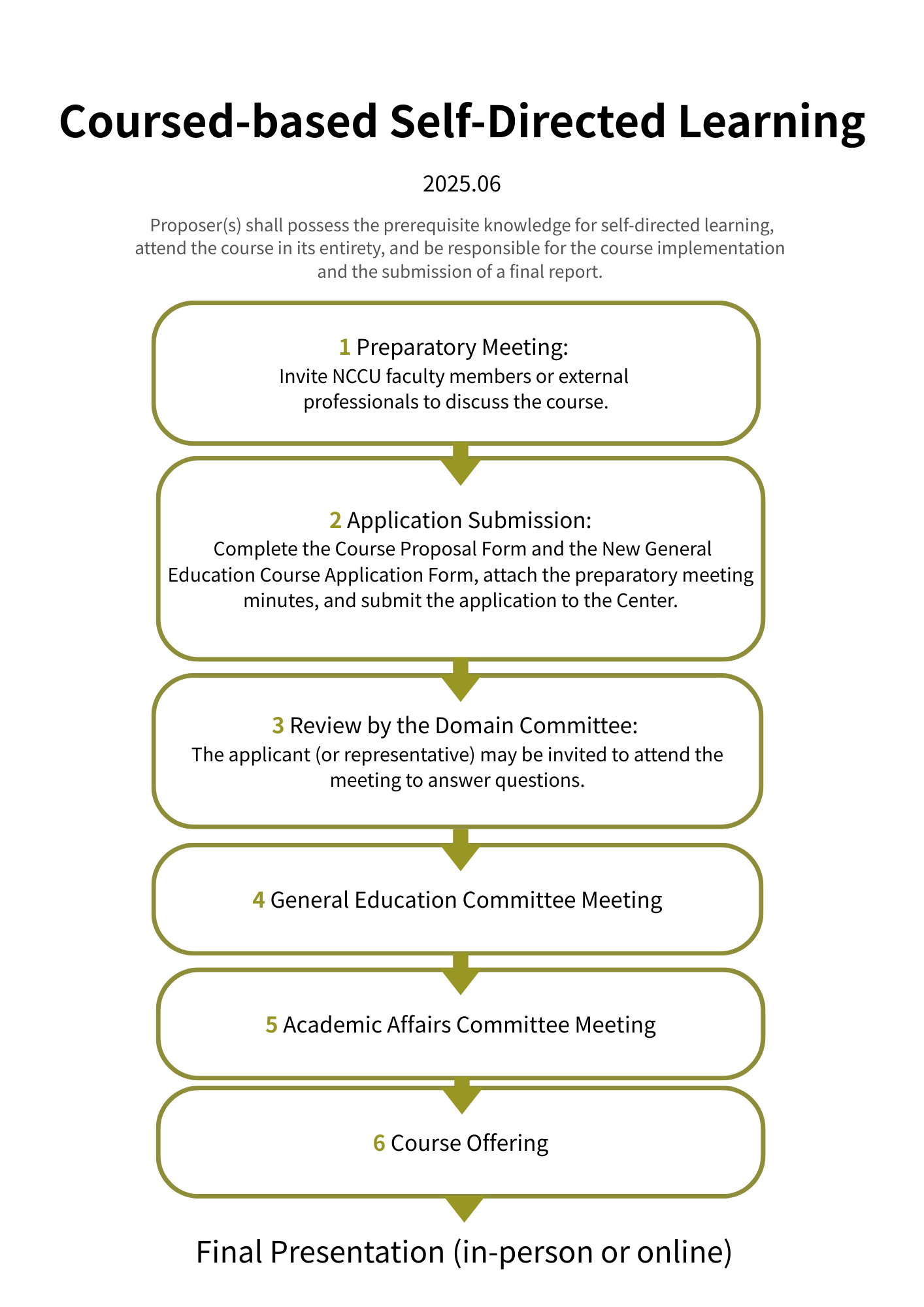
One or more undergraduate students at NCCU should submit a self-directed learning plan and relevant application documents as announced by the Center of General Education (hereinafter referred as “the Center”). Proposers shall possess the prerequisite knowledge for self-directed learning, attend the course in its entirety, and be responsible for the course implementation and the submission of a final report. Failure to fulfill any of these requirements without just cause will result in disqualification from submitting proposals for a period of two years.
Review Process
The self-directed learning proposal must first be reviewed by the Center, and then evaluated by the College General Education Domain Review Committee. The course will only be offered upon approval by both the General Education Committee and the Academic Affairs Council.
Hourly lecture fee and funding sources
- The course budget shall be capped at the product of the hourly pay rate for professors, the number of credits, and the number of instructional weeks. Funding may come from government subsidies or the University’s self-generated revenue. Duplicate applications for other subsidies from the Office of Academic Affairs are not permitted.
- In accordance with Ministry of Education regulations, instructors shall be compensated based on their actual teaching hours. Since these courses fall outside the regular degree programs, the teaching hours shall not count toward the full-time faculty member’s official teaching load for the academic year.
- Instructors are responsible for the overall management of the course and the assessment of student performance. If the actual teaching hours are less than half of the total scheduled hours, the instructor may instead be compensated at the rate applicable for supervising a master’s thesis.